

Kamagra and Heart Disease: Complete Guide to ED Treatment in Men with Cardiac Conditions
KamagraAdmin
June 3, 2026
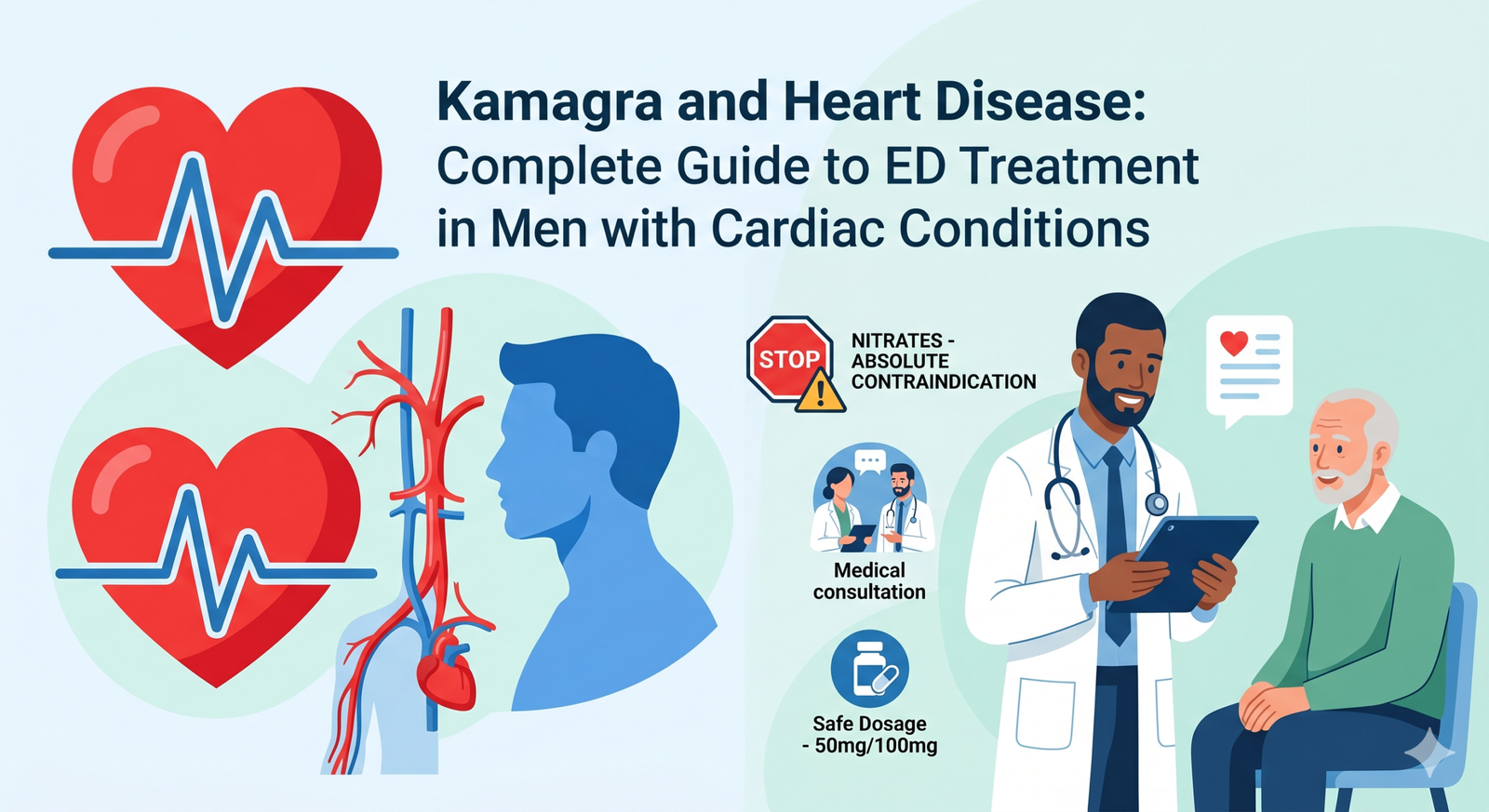
Kamagra and Heart Disease: Complete Guide to ED Treatment in Men with Cardiac Conditions
Table of Contents
Introduction
Understanding Heart Disease and Erectile Dysfunction
Why Heart Disease Causes Erectile Dysfunction
Prevalence of ED in Men with Heart Disease
How Kamagra Works in Men with Heart Disease
Cardiac Safety of Kamagra
Nitrate Medications and Absolute Contraindication
Cardiac Medication Interactions
Cardiovascular Assessment Before Using Kamagra
Dosage Considerations for Cardiac Patients
Effectiveness in Men with Heart Disease
Side Effects in Cardiac Population
Safety Precautions for Cardiac Patients
Frequently Asked Questions
Conclusion
Introduction
Erectile dysfunction is a common complication of heart disease, affecting approximately 50% to 70% of men with cardiac conditions. Heart disease damages blood vessels essential for erectile function and can impair the body’s ability to achieve and maintain erections. Additionally, cardiac medications, particularly nitrates, can cause erectile dysfunction.
Kamagra offers an effective treatment option for erectile dysfunction in men with heart disease, though cardiac safety considerations are paramount. Men with heart disease must undergo careful cardiovascular assessment before using Kamagra to ensure safety.
This comprehensive guide explores the relationship between heart disease and erectile dysfunction, explains how Kamagra works in men with cardiac conditions, addresses cardiac safety considerations and medication interactions, and provides guidance on safe use of Kamagra for men with heart disease.
Understanding Heart Disease and Erectile Dysfunction
Heart disease significantly increases the risk of erectile dysfunction through multiple physiological mechanisms.
Coronary Artery Disease is the most common form of heart disease, characterized by narrowing of coronary arteries due to atherosclerotic plaque. Coronary artery disease impairs blood flow to the heart muscle and increases risk of myocardial infarction.
Heart Failure is a condition where the heart cannot pump blood effectively. Heart failure can be systolic (reduced ejection fraction) or diastolic (preserved ejection fraction).
Arrhythmias are abnormal heart rhythms that can impair cardiac function and increase risk of stroke and other complications.
Valvular Heart Disease involves dysfunction of heart valves, which can impair cardiac function.
Cardiomyopathy is disease of the heart muscle that impairs cardiac function.
Prevalence in Men shows that approximately 6% to 8% of men have some form of heart disease, and this prevalence increases significantly with age.
Why Heart Disease Causes Erectile Dysfunction
Heart disease causes erectile dysfunction through multiple physiological mechanisms.
Vascular Damage is the primary mechanism. Atherosclerosis that affects coronary arteries also affects blood vessels throughout the body, including those supplying the penis. Atherosclerotic narrowing of penile blood vessels impairs blood flow and erectile function.
Endothelial Dysfunction involves reduced nitric oxide production and increased oxidative stress. These changes reduce blood vessel responsiveness to sexual stimulation and impair the ability to achieve erections.
Reduced Cardiac Output in men with heart failure reduces blood pressure and blood flow throughout the body, including to the penis. Reduced blood flow impairs erectile function.
Medication Side Effects are a significant cause of erectile dysfunction in men with heart disease. Many cardiac medications, particularly beta-blockers and some antihypertensive medications, can cause erectile dysfunction as a side effect.
Psychological Factors including depression, anxiety, and reduced sexual confidence are more common in men with heart disease and can contribute to erectile dysfunction.
Fatigue and Reduced Exercise Tolerance associated with heart disease can reduce sexual activity and contribute to erectile dysfunction.
Prevalence of ED in Men with Heart Disease
Erectile dysfunction is significantly more common in men with heart disease compared to men without heart disease.
Overall Prevalence of erectile dysfunction in men with heart disease is approximately 50% to 70%, compared to 5% to 10% in men without heart disease. This represents a 5 to 14-fold increased risk.
Coronary Artery Disease shows that approximately 50% to 60% of men with coronary artery disease experience erectile dysfunction.
Heart Failure shows that approximately 60% to 70% of men with heart failure experience erectile dysfunction.
Post-Myocardial Infarction shows that approximately 40% to 50% of men who have suffered a myocardial infarction experience erectile dysfunction.
Age-Related Prevalence shows that erectile dysfunction becomes increasingly common with age in both men with and without heart disease. However, men with heart disease develop erectile dysfunction at younger ages.
How Kamagra Works in Men with Heart Disease
Kamagra works through the same mechanism in men with and without heart disease, though cardiac considerations are important.
Mechanism of Action involves inhibition of phosphodiesterase-5 (PDE-5), promoting smooth muscle relaxation and blood vessel dilation in the penis. This increased blood flow enables erectile function.
Effectiveness in Vascular Disease is maintained despite atherosclerotic damage. Kamagra can promote blood vessel dilation even in vessels damaged by atherosclerosis, though the degree of response may be reduced.
Effectiveness in Heart Failure is reduced due to reduced cardiac output. Men with significant heart failure may have reduced response to Kamagra.
Nitric Oxide Pathway is the critical pathway for Kamagra’s effectiveness. Kamagra works downstream of nitric oxide production, meaning it can enhance erectile function even when nitric oxide production is impaired by heart disease.
Cardiac Safety of Kamagra
Cardiac safety is the primary consideration for men with heart disease using Kamagra.
Blood Pressure Effects of Kamagra are important in cardiac patients. Kamagra causes modest reductions in blood pressure, typically 5-10 mmHg. In men with well-controlled blood pressure, this effect is usually tolerable. However, in men with poorly controlled blood pressure or taking multiple antihypertensive medications, blood pressure reductions may be excessive.
Cardiac Workload during sexual activity is similar to moderate physical activity. Men who can safely engage in moderate physical activity can typically safely use Kamagra.
Myocardial Infarction Risk is not increased by Kamagra use in men with stable coronary artery disease. However, sexual activity itself can precipitate myocardial infarction in men with unstable coronary artery disease.
Arrhythmia Risk is not increased by Kamagra use in men with stable arrhythmias. However, men with unstable arrhythmias should avoid sexual activity and Kamagra.
Heart Failure Considerations are important. Men with significant heart failure may have reduced response to Kamagra and may have increased risk of adverse effects due to reduced cardiac output.
Nitrate Medications and Absolute Contraindication
Nitrate medications represent an absolute contraindication with Kamagra.
Nitrate Medications include nitroglycerin, isosorbide dinitrate, isosorbide mononitrate, and other nitrate formulations used for angina treatment.
Mechanism of Interaction involves additive vasodilation. Both nitrates and sildenafil promote vasodilation through different mechanisms. Combined use can cause severe, potentially life-threatening vasodilation and blood pressure drops.
Severity of Interaction is extreme. The combination of nitrates and sildenafil can cause blood pressure drops of 30-40 mmHg or more, leading to syncope, myocardial infarction, and death.
Absolute Contraindication means that men taking nitrate medications must absolutely not take Kamagra or any other PDE5 inhibitor. This is a non-negotiable safety requirement.
Alternative Treatments for men taking nitrates include other ED treatments such as vacuum erection devices, penile injections, or penile implants. Medical consultation is necessary to identify safe alternatives.
Timing Considerations are important. Nitrates and sildenafil should not be taken within 24 hours of each other. Men must wait at least 24 hours after taking a nitrate before taking Kamagra.
Cardiac Medication Interactions
Several cardiac medications can interact with Kamagra.
Beta-Blockers such as metoprolol and atenolol do not directly interact with Kamagra, though both medications can cause erectile dysfunction. The combination is generally safe, though blood pressure monitoring is recommended.
ACE Inhibitors such as lisinopril do not directly interact with Kamagra, though both medications can cause blood pressure reductions. The combination is generally safe, though blood pressure monitoring is recommended.
Angiotensin Receptor Blockers such as losartan do not directly interact with Kamagra. The combination is generally safe, though blood pressure monitoring is recommended.
Calcium Channel Blockers such as amlodipine do not directly interact with Kamagra. The combination is generally safe, though blood pressure monitoring is recommended.
Statins such as atorvastatin do not interact with Kamagra.
Anticoagulants such as warfarin do not interact with Kamagra.
Antiplatelet Agents such as aspirin do not interact with Kamagra.
Alpha-Blockers such as doxazosin can interact with Kamagra and cause excessive blood pressure drops. Medical consultation is recommended for men taking alpha-blockers.
Cardiovascular Assessment Before Using Kamagra
Comprehensive cardiovascular assessment is essential before men with heart disease use Kamagra.
Baseline Assessment should include blood pressure measurement, heart rate assessment, electrocardiogram (ECG), and review of cardiac symptoms. Men with significant cardiac symptoms should seek medical evaluation before using Kamagra.
Exercise Tolerance Assessment is a useful indicator of cardiovascular safety. Men who can safely engage in moderate physical activity (equivalent to climbing two flights of stairs or walking 3-4 miles per hour on level ground) can typically safely use Kamagra.
Cardiac Risk Stratification should be performed by a cardiologist. Men should be classified as low-risk, intermediate-risk, or high-risk based on their cardiac condition and exercise tolerance.
Low-Risk Patients include men with no symptoms of cardiac disease, normal exercise tolerance, and well-controlled cardiac risk factors. These men can typically safely use Kamagra.
Intermediate-Risk Patients include men with mild to moderate cardiac disease or reduced exercise tolerance. These men may be able to use Kamagra with medical consultation and careful monitoring.
High-Risk Patients include men with unstable angina, recent myocardial infarction (within 2 weeks), uncontrolled arrhythmias, uncontrolled hypertension, or severe heart failure. These men should not use Kamagra until their cardiac condition is stabilized.
Medical Consultation is essential. Men with heart disease should consult with a cardiologist before using Kamagra.
Dosage Considerations for Cardiac Patients
Dosage selection for men with heart disease requires careful consideration.
Standard Dosage of 100mg is appropriate for low-risk cardiac patients with well-controlled cardiac conditions.
Lower Dosage of 50mg is appropriate for intermediate-risk cardiac patients, cardiac patients over 65 years of age, cardiac patients taking multiple medications, and cardiac patients with reduced exercise tolerance.
Higher Dosage of 150mg should be avoided in cardiac patients due to increased risk of adverse cardiac effects.
Dose Titration should be gradual. Men should start with lower doses and increase only if necessary and under medical guidance.
Medical Consultation is essential for dosage selection in cardiac patients.
Effectiveness in Men with Heart Disease
Kamagra’s effectiveness in men with heart disease is somewhat lower than in men without heart disease.
Response Rate in men with heart disease is approximately 65% to 75%, compared to 80% to 85% in men without heart disease.
Factors Affecting Response include severity of cardiac disease, exercise tolerance, presence of other vascular disease, and medication side effects. Men with mild cardiac disease respond better than men with severe cardiac disease.
Time to Response may be longer in men with heart disease. Some men require several uses of Kamagra before achieving optimal response.
Cardiac Condition Stability is important. Men with unstable cardiac conditions may have reduced response to Kamagra.
Side Effects in Cardiac Population
Side effect rates in men with heart disease are similar to men without heart disease, though some differences exist.
Headache occurs in approximately 15-20% of men with heart disease, similar to men without heart disease.
Flushing occurs in approximately 10-15% of men with heart disease, similar to men without heart disease.
Dizziness may occur at higher rates in men with heart disease due to blood pressure-lowering effects and reduced cardiac output. Approximately 5-10% of men with heart disease experience dizziness.
Syncope is a rare but serious side effect more likely in men with heart disease, particularly those with reduced cardiac output or taking multiple antihypertensive medications.
Chest Pain is a serious side effect requiring immediate medical attention. Men experiencing chest pain should seek emergency medical care.
Arrhythmias are rare but serious side effects requiring immediate medical attention.
Safety Precautions for Cardiac Patients
Men with heart disease should take specific precautions when using Kamagra.
Cardiologist Consultation is essential. Men with heart disease should consult with a cardiologist before using Kamagra.
Nitrate Avoidance is absolute. Men taking nitrate medications must not take Kamagra.
Blood Pressure Monitoring is important. Men should monitor blood pressure before and after Kamagra use.
Cardiac Symptom Monitoring is important. Men should monitor for chest pain, shortness of breath, palpitations, or syncope.
Alcohol Avoidance is particularly important for men with heart disease, as alcohol combined with Kamagra can cause excessive blood pressure drops.
Activity Limitation may be necessary. Men with reduced exercise tolerance should avoid strenuous activity when using Kamagra.
Emergency Planning is important. Men should know how to access emergency medical care if needed.
Frequently Asked Questions
Can men with heart disease take Kamagra?
Some men with heart disease can safely take Kamagra. However, comprehensive cardiovascular assessment by a cardiologist is essential.
Can I take Kamagra if I’m taking a nitrate medication?
No, absolutely not. The combination of Kamagra and nitrates can cause severe, potentially life-threatening blood pressure drops.
Is Kamagra safe after a heart attack?
Kamagra can typically be used safely at least 2 weeks after a myocardial infarction, provided the patient has recovered well and has medical clearance.
Can I take Kamagra if I have heart failure?
This depends on the severity of heart failure. Men with mild to moderate heart failure may be able to use Kamagra with medical consultation. Men with severe heart failure should not use Kamagra.
Should I tell my cardiologist I’m taking Kamagra?
Yes, absolutely. Your cardiologist needs to know about all medications and supplements you’re taking.
What should I do if I experience chest pain while using Kamagra?
Seek emergency medical care immediately. Chest pain could indicate a serious cardiac event.
Conclusion
Kamagra can offer an effective treatment option for erectile dysfunction in men with heart disease, provided comprehensive cardiovascular assessment is performed and appropriate precautions are taken. Men with heart disease must consult with a cardiologist before using Kamagra. Absolute contraindications such as nitrate medications must be respected. With proper medical guidance and careful monitoring, many men with heart disease can safely use Kamagra and restore erectile function.