

Kamagra Dosage Variations: Complete Guide to 50mg, 100mg, and 150mg Options
KamagraAdmin
May 29, 2026
Kamagra Dosage Variations: Complete Guide to 50mg, 100mg, and 150mg Options
Table of Contents
Introduction
Understanding Sildenafil Dosages
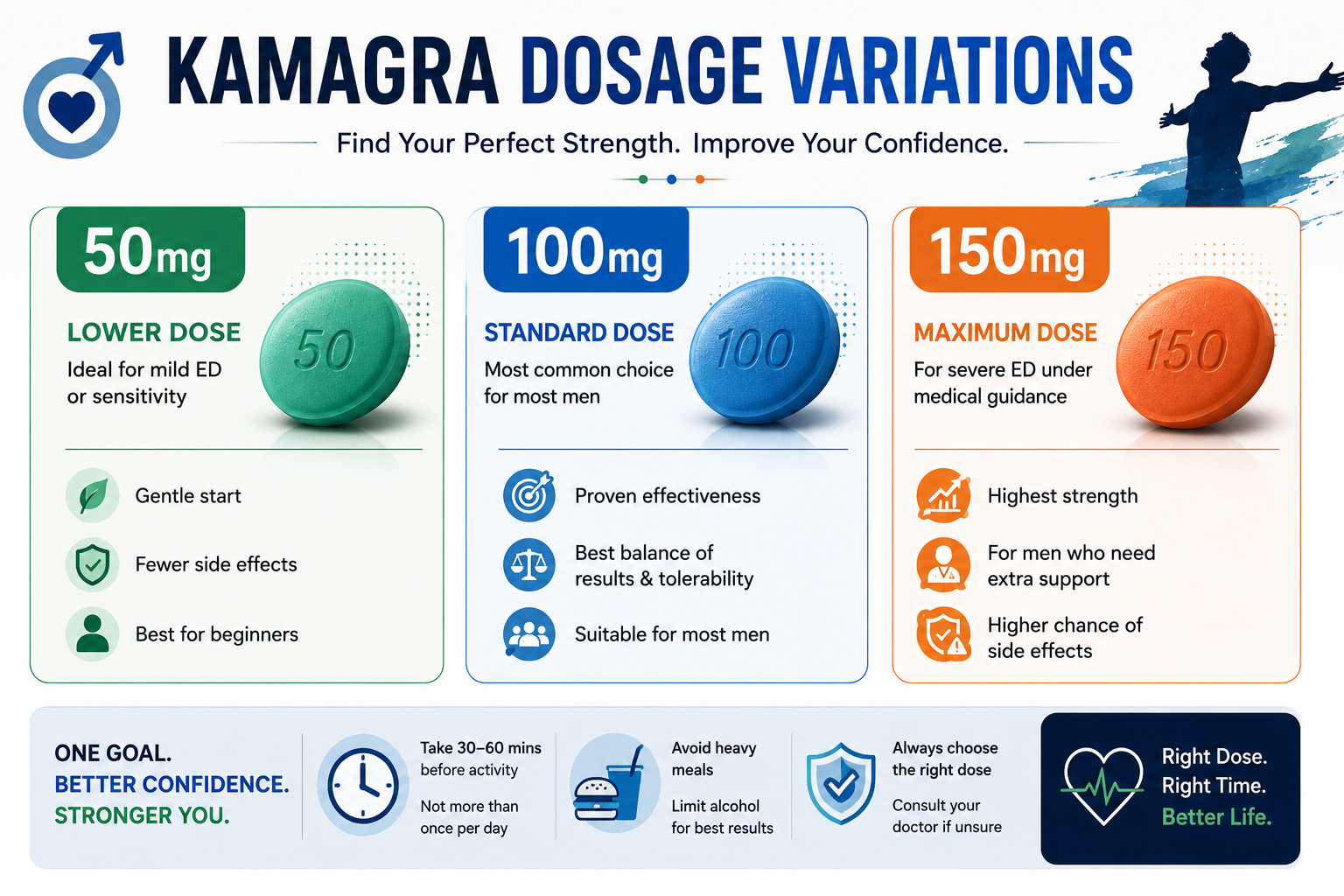
Kamagra 50mg: The Lower Dose Option
Kamagra 100mg; The Standard Therapeutic Dose
Kamagra 150mg: The Maximum Dose
How to Choose Your Dosage
Dosage Adjustments and Titration
Age and Dosage Considerations
Medical Conditions and Dosage
Effectiveness Across Different Dosages
Side Effects by Dosage Level
Cost Comparison Across Dosages
Dosage Timing and Administration
Frequently Asked Questions
Conclusion
Introduction
Kamagra dosage variations represent a critical consideration for men selecting erectile dysfunction treatment. The availability of multiple dosage options-50mg, 100mg, and 150mg-allows men to select doses that match their individual needs, health status, and response to sildenafil. Understanding the differences between dosage options, how to select the appropriate dose, and how dosage affects effectiveness and side effects helps men make informed treatment decisions.
The standard therapeutic dose of sildenafil is 100mg, but individual variation in response to the medication is substantial. Some men respond adequately to the 50mg dose and experience fewer side effects, while others require the 150mg dose for adequate therapeutic response. This comprehensive guide explores all three dosage options, helping men understand how to select the most appropriate dose for their individual circumstances.
Understanding Sildenafil Dosages
Sildenafil, the active ingredient in Kamagra, is available in multiple dosages because individual response to the medication varies substantially between men. Pharmaceutical research has established that sildenafil is effective across a range of doses, with 50mg representing the minimum effective dose and 150mg representing the maximum recommended dose.
The relationship between dosage and effectiveness is not linear. Doubling the dose does not double the effectiveness. Instead, effectiveness increases in a dose-dependent manner, with each increase in dose producing a smaller incremental improvement in effectiveness. This dose-response relationship explains why some men achieve adequate therapeutic response at lower doses, while others require higher doses for similar results.
Individual variation in sildenafil response is influenced by multiple factors including age, baseline erectile function, comorbid medical conditions, concurrent medications, body weight, and individual genetic variation in drug metabolism. Men with mild erectile dysfunction often respond adequately to lower doses, while men with moderate to severe erectile dysfunction typically require higher doses.
The pharmacokinetics of sildenafil-how the body absorbs, distributes, metabolizes, and eliminates the drug-also influences dosage selection. Peak plasma concentrations are reached between 30 and 120 minutes after oral administration. The half-life of sildenafil is approximately 4 hours, meaning that half of the medication is eliminated from the body approximately 4 hours after ingestion.
Kamagra 50mg: The Lower Dose Option
Kamagra 50mg represents the lowest standard dosage available and is appropriate for specific populations of men. The 50mg dose is particularly suitable for men who are sensitive to sildenafil, men with mild erectile dysfunction, and men with complicating medical factors that increase the risk of adverse effects.
Appropriate Candidates for 50mg include men over 65 years of age, men with mild erectile dysfunction, men with hepatic impairment, men with renal impairment, men taking medications that inhibit CYP3A4 metabolism, and men who have experienced side effects with higher doses. The 50mg dose provides an excellent starting point for men who have never used sildenafil and who want to assess their individual response before moving to higher doses.
Effectiveness of 50mg is substantial, with clinical studies demonstrating that approximately 60% to 70% of men with erectile dysfunction respond adequately to the 50mg dose. Men with mild erectile dysfunction experience success rates of 75% to 85% with the 50mg dose. Men with moderate to severe erectile dysfunction typically require higher doses for adequate therapeutic response.
Side Effects with 50mg are generally mild and occur less frequently than with higher doses. Headache occurs in approximately 8% to 12% of men taking 50mg, compared to 15% to 20% with 100mg. Flushing occurs in approximately 5% to 8% of men taking 50mg. The lower incidence of side effects makes the 50mg dose attractive for men who are concerned about adverse effects.
Cost of 50mg is typically slightly lower than 100mg, though the difference is minimal. Some retailers offer 50mg sachets of oral jelly or tablets at prices approximately 10% to 20% lower than 100mg options. For men taking the medication regularly, the cost savings with 50mg are modest but can accumulate over time.
Kamagra 100mg: The Standard Therapeutic Dose
Kamagra 100mg represents the standard therapeutic dose and is appropriate for most men with erectile dysfunction.
Effectiveness of 100mg is well-established through extensive clinical research.
Side Effects with 100mg are generally mild and temporary.
Onset Time with 100mg is typically 30 to 60 minutes for tablets and 15 to 30 minutes for oral jelly formulations.
Cost of 100mg represents the standard pricing reference.
Kamagra 150mg: The Maximum Dose
Kamagra 150mg represents the maximum recommended dose and is appropriate for men who do not respond adequately to the 100mg dose. The 150mg dose should only be used under medical guidance and is not recommended as a starting dose.
Appropriate Candidates for 150mg include men with severe erectile dysfunction who have not responded to the 100mg dose, men with significant comorbid medical conditions affecting erectile function, and men taking medications that reduce sildenafil effectiveness. The 150mg dose is not appropriate for men over 65 years of age without medical evaluation, men with cardiovascular disease, or men with hepatic or renal impairment.
Effectiveness of 150mg is higher than 100mg but the incremental improvement is modest. Clinical studies demonstrate that approximately 85% to 90% of men respond adequately to the 150mg dose, compared to 80% to 85% with 100mg. The incremental improvement of 5% represents a modest increase in effectiveness.
Side Effects with 150mg are more frequent and potentially more severe than with lower doses. Headache occurs in approximately 25% to 30% of men taking 150mg. Flushing occurs in approximately 15% to 20% of men. Indigestion occurs in approximately 10% to 15% of men. The increased incidence of side effects makes the 150mg dose less attractive for men concerned about adverse effects.
Serious Side Effects with 150mg are rare but more likely than with lower doses. Priapism, defined as a prolonged erection lasting more than four hours, occurs in approximately 0.1% to 0.2% of men taking 150mg, compared to less than 0.1% with 100mg. Sudden vision loss or hearing loss, while extremely rare, may be more likely with higher doses.
Cost of 150mg is typically 10% to 20% higher than 100mg, reflecting the higher active ingredient content. For men using the medication regularly, the increased cost of 150mg may be a consideration.
How to Choose Your Dosage
Selecting the appropriate dosage requires consideration of multiple factors including severity of erectile dysfunction, age, medical history, concurrent medications, and individual response to sildenafil.
Starting Dose Recommendations typically begin with 100mg for most men without significant comorbid conditions. Men over 65 years of age, men with hepatic or renal impairment, and men taking medications that inhibit sildenafil metabolism should start with 50mg. Men with severe erectile dysfunction or significant comorbid conditions may benefit from starting with 100mg and potentially increasing to 150mg if needed.
Assessing Response to the starting dose is important before adjusting dosage. Men should use the starting dose for at least 3 to 4 sexual encounters before determining whether the dose is adequate. Individual response varies, and some men require multiple uses to fully assess effectiveness.
Dose Adjustment should proceed gradually. If the starting dose is inadequate, the dose should be increased to the next available option. If side effects are problematic, the dose should be decreased to the next lower option. Dose adjustments should be made incrementally rather than jumping to the maximum dose.
Medical Consultation is recommended for men with significant comorbid conditions, men taking multiple medications, men over 65 years of age, or men considering doses higher than 100mg. Healthcare providers can assess individual risk factors and recommend appropriate dosages.
Dosage Adjustments and Titration
Dosage titration-the process of adjusting dose based on response-is a standard approach to optimizing sildenafil therapy.
Upward Titration is appropriate for men who do not respond adequately to their starting dose. If the 50mg dose is inadequate, the dose can be increased to 100mg. If the 100mg dose is inadequate, the dose can be increased to 150mg. Upward titration should proceed gradually, with at least 3 to 4 uses at each dose level before increasing further.
Downward Titration is appropriate for men experiencing problematic side effects. If side effects are intolerable at 100mg, the dose can be decreased to 50mg. Downward titration often results in improved tolerability while maintaining adequate therapeutic effectiveness.
Dose Stabilization occurs when men find a dose that provides adequate therapeutic response with acceptable side effects. Most men stabilize on the 100mg dose, though some stabilize on 50mg and others require 150mg.
Long-Term Dosage should be reviewed periodically. Some men find that their response to a particular dose changes over time, requiring dose adjustment. Regular assessment of effectiveness and side effects helps ensure that the current dose remains optimal.
Age and Dosage Considerations
Age significantly influences appropriate dosage selection and sildenafil response.
Men Under 40 typically respond well to lower doses. The 50mg dose often provides adequate therapeutic response for men in this age group. Metabolism is typically efficient, and side effects are generally minimal. Men under 40 should start with 50mg or 100mg rather than the maximum dose.
Men 40-65 represent the typical population using sildenafil. The 100mg dose is appropriate for most men in this age group. Metabolism remains relatively efficient, and comorbid conditions are less common than in older men.
Men Over 65 require special dosage considerations. Metabolism becomes less efficient with age, and comorbid conditions become more common. Men over 65 should typically start with 50mg and increase to 100mg if needed. The 150mg dose is generally not recommended for men over 65 without medical evaluation.
Elderly Men with Comorbidities require careful dosage selection. Men over 75 with significant comorbid conditions should typically use 50mg doses. Medical consultation is recommended for this population.
Medical Conditions and Dosage
Specific medical conditions influence appropriate dosage selection.
Cardiovascular Disease requires careful dosage selection. Men with stable angina, previous myocardial infarction, or controlled hypertension can typically use sildenafil, but lower doses are often recommended. Men with unstable angina, uncontrolled hypertension, or recent myocardial infarction should avoid sildenafil entirely.
Diabetes affects sildenafil response. Men with diabetes often require higher doses than men without diabetes. The 100mg dose is often appropriate for men with well-controlled diabetes, while men with poorly controlled diabetes may require 150mg.
Hepatic Impairment requires dose reduction. Men with hepatic impairment should use 50mg doses due to reduced metabolism of sildenafil. The 100mg and 150mg doses are contraindicated in men with significant hepatic impairment.
Renal Impairment requires dose adjustment. Men with renal impairment should use 50mg doses due to reduced elimination of sildenafil. The 100mg and 150mg doses are contraindicated in men with significant renal impairment.
Medical Conditions and Dosage
Specific medical conditions influence appropriate dosage selection.
Cardiovascular Disease requires careful dosage selection. Men with stable angina, previous myocardial infarction, or controlled hypertension can typically use sildenafil, but lower doses are often recommended. Men with unstable angina, uncontrolled hypertension, or recent myocardial infarction should avoid sildenafil entirely.
Diabetes affects sildenafil response. Men with diabetes often require higher doses than men without diabetes. The 100mg dose is often appropriate for men with well-controlled diabetes, while men with poorly controlled diabetes may require 150mg.
Hepatic Impairment requires dose reduction. Men with hepatic impairment should use 50mg doses due to reduced metabolism of sildenafil. The 100mg and 150mg doses are contraindicated in men with significant hepatic impairment.
Renal Impairment requires dose adjustment. Men with renal impairment should use 50mg doses due to reduced elimination of sildenafil. The 100mg and 150mg doses are contraindicated in men with significant renal impairment.
Effectiveness Across Different Dosages
Side Effects by Dosage LevelClinical research demonstrates clear dose-response relationships for sildenafil effectiveness.
| Dosage | Success Rate | Mild ED | Moderate ED | Severe ED |
50mg
| 65-75% | 80-85% | 60-70% | 40-50% |
100mg
| 80-85% | 85-90% | 75-85% | 50-65% |
150mg
| 85-90% | 90-95% | 80-90% | 65-75% |
The data demonstrates that higher doses produce higher success rates, but the incremental improvement decreases as doses increase. The difference between 50mg and 100mg is substantial (approximately 15% improvement), while the difference between 100mg and 150mg is modest (approximately 5% improvement).
Side Effects by Dosage Level
Side effect incidence increases with dosage.
| Side Effect | 50mg | 100mg | 150mg |
Headache
| 8-12% | 15-20% | 25-30% |
Flushing
| 5-8% | 10-15% | 15-20% |
Indigestion
| 3-5% | 5-10% | 10-15% |
Nasal Congestion
| 3-5% | 5-8% | 8-10% |
Serious Side Effects
| <0.1% | <0.1% | 0.1-0.2% |
The data demonstrates that side effect incidence increases substantially with dosage. Men concerned about side effects should start with lower doses.
Cost Comparison Across Dosages
Cost varies modestly across dosages, with higher doses typically costing slightly more.
| Dosage | Cost Per Tablet | Monthly Supply | Annual Cost |
50mg
| £0.60-£1.20 | £5-£10 | £60-£120 |
100mg
| £0.75-£1.50 | £6-£12 | £72-£144 |
150mg
| £0.90-£1.80 | £7-£14 | £84-£168 |
The cost differences between dosages are modest, typically 10% to 20%. For men using the medication regularly, the cost difference between 50mg and 150mg is approximately £24 to £48 annually.
Dosage Timing and Administration
Proper timing and administration of different dosages is important for optimal effectiveness.
Timing Before Sexual Activity varies slightly by dosage and formulation. The 50mg and 100mg doses typically begin working within 30 to 60 minutes for tablets and 15 to 30 minutes for oral jelly. The 150mg dose has similar onset time but may reach peak effectiveness slightly faster due to higher concentration.
Administration with Food affects all dosages similarly. Taking sildenafil on an empty stomach typically results in faster onset compared to taking with food. High-fat meals can delay onset and reduce peak effectiveness.
Alcohol Interaction affects all dosages. Alcohol consumption can reduce effectiveness and increase side effects. Men should avoid alcohol or limit consumption to moderate amounts when using sildenafil.
Frequency of Use should not exceed once per day regardless of dosage. Men should not take sildenafil more frequently than once per 24 hours
Frequently Asked Questions
Which dosage should I start with?
Most men should start with 100mg.
Can I increase my dose if 100mg doesn’t work?
Yes.
Can I decrease my dose if I experience side effects?
Yes.
Is 150mg safe?
Yes, 150mg is safe for most men, but it carries higher risk of side effects.
How long does each dosage last?
All dosages last approximately 4-6 hours regardless of dose.
Can I take a higher dose for faster onset?
No.
Which dosage is most cost-effective?
100mg offers the best balance of effectiveness and cost for most men.
Can I switch between dosages?
Yes.
Conclusion
Kamagra dosage variations provide flexibility in selecting treatment that matches individual needs and response.